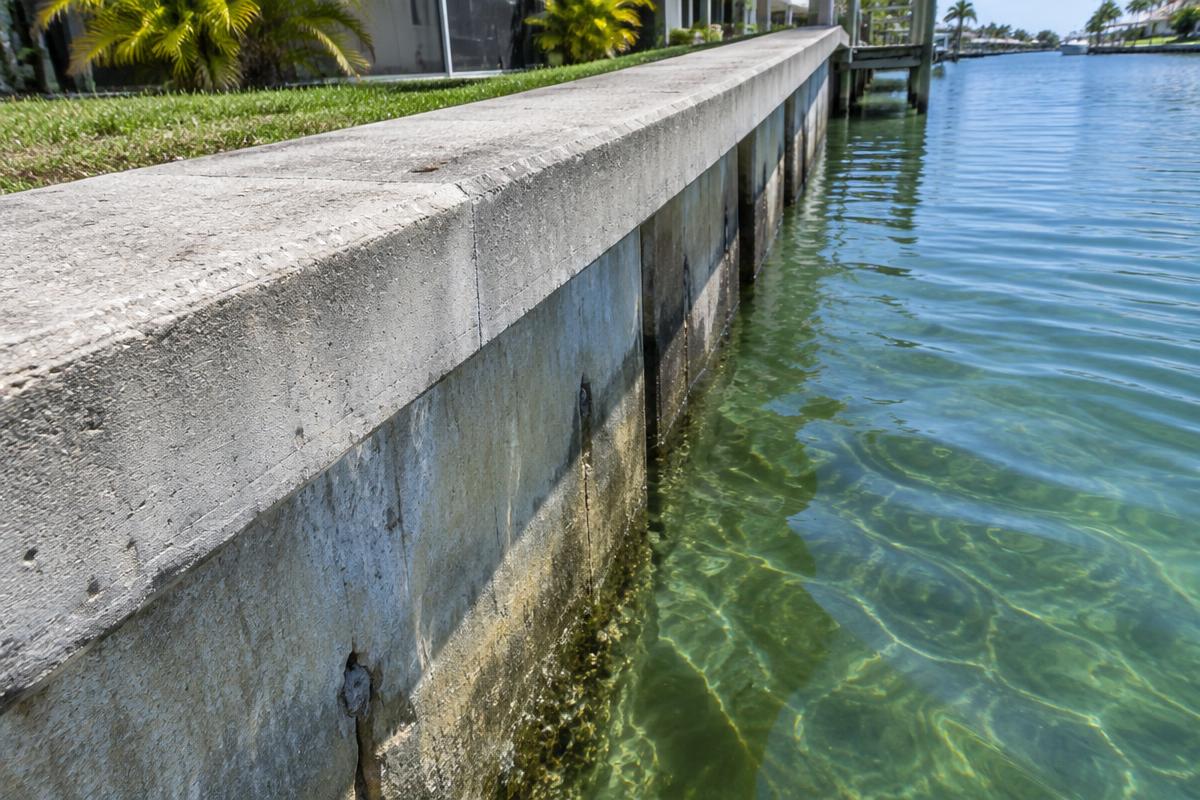
When Replacement Becomes the Better Investment
Seawall replacement means removing or encapsulating the existing wall and building a new structural system — new sheet piles, a new cap, and new tiebacks or anchors.
There are two common routes. A full tear-out removes the old wall entirely. A new wall can also be installed directly in front of the existing one, which can reduce disturbance to the yard but slightly reduces waterway width.
Which route fits depends on the condition of the existing wall, the canal width, neighboring walls, dock and lift connections, and what local rules allow.
Signs You May Be Looking at Replacement
Repeated repairs in different places
When a new problem shows up every season, the wall as a whole is likely wearing out.
Significant lean or displacement
A wall that has rotated noticeably toward the water may no longer be economical to hold in place.
Widespread cracking and rust staining
Corrosion inside the concrete tends to spread, and repairs have a hard time keeping up.
Height or code concerns
Some cities have adopted minimum seawall elevation standards. An older, lower wall may not meet them.
Seawall Replacement Options
Concrete sheet pile walls
A long-standing standard in South Florida canals, paired with a poured concrete cap.
Vinyl or composite sheet piles
Corrosion-resistant sheet piles often chosen for residential canals, typically finished with a concrete cap.
Steel sheet piles
Common where higher loads or deeper water are involved, with coatings to manage corrosion.
Install-in-front vs. tear-out
Placing the new wall in front of the old one versus removing it — each has trade-offs in cost, disruption and waterway width.
Not sure what your seawall needs?
Tell us what you're seeing. We'll help you get connected with a marine professional for an evaluation.
Planning a Seawall Replacement
Replacement projects usually involve engineering, permitting and coordination with neighbors, so the earlier you start the conversation, the better. Good planning also makes it easier to fold in a new dock or boat lift while the waterfront is already open.
Start with a clear picture of the existing wall. A professional seawall inspection helps confirm whether replacement is really needed or whether targeted seawall repair still makes sense.
South Florida Factors That Shape a New Wall
Wall elevation is a bigger conversation than it used to be. With rising tides and local resilience standards, many owners are building new caps higher than the wall they're replacing.
Access matters too. Tight canal lots often mean the work happens from a barge, which affects scheduling and cost.
We work with property owners across Broward, Miami-Dade and Palm Beach counties.
Who Typically Replaces Seawalls
Homeowners
Especially when renovating, selling, or tired of chasing repairs.
Condo associations and HOAs
Long shared walls that benefit from phased planning and reserve budgeting.
Developers and commercial owners
Redevelopment sites where the new wall needs to support new structures.
Seawall Replacement FAQs
How long does a seawall replacement take?
It varies with wall length, access and permitting. Permitting and engineering often take longer than the construction itself, so it's smart to start planning early.
Can a new seawall be built in front of the old one?
Often, yes, where local rules and waterway width allow it. It can limit yard disturbance, but it's not the right fit for every property.
Will my dock need to come out?
Frequently, at least partially, since docks and lifts are usually tied into or near the wall. Many owners use replacement as the time to upgrade their dock too.
How long will a new seawall last?
It depends on materials, installation quality and exposure. Our article on how long a seawall lasts in Florida walks through the factors.